The Future Does Not Have to Be New
Sean Carroll has apparently found a way for the universe to do something competitive Pokémon had the very good sense to ban.
The proposal comes from Carroll, Nadiia Diachenko, and Saakshi Dulani in a recent paper with the extremely restrained title Toward a Phenomenologically Acceptable Quantum Cyclic Universe.
Their universe comes back.
All the way back.
The basic setup begins with a finite-dimensional quantum system evolving unitarily. Under ordinary assumptions, such a system is recurrent: wait long enough and the state can come arbitrarily close to where it started.
That creates an old cosmological problem. A universe spending almost all of eternity near thermal equilibrium should produce tiny random fluctuations far more often than vast low-entropy worlds like ours. Observers assembled as brief equilibrium accidents (Boltzmann brains) threaten to overwhelm ordinary cosmological observers in the accounting.
So then Carroll, Diachenko, and Dulani construct a loophole.
- Choose the energy spectrum so the relevant differences are commensurable.
- Choose a very special low-entropy initial condition.
- The state no longer wanders around waiting for an approximate recurrence.
- It becomes exactly periodic.

The quantum state follows a closed trajectory and returns exactly to itself after a finite period. The low-entropy excursion can return with it, giving the model something interpretable as a Big Bang, later evolution toward equilibrium, a Big Crunch, another bounce, and then the same structure again.
The authors are very clear about the price. The construction is deliberately non-generic, and its spacetime interpretation remains speculative. They have found a possible architecture, not announced the cosmology of our universe.
Still.
This is more than enough to cause trouble.

Modal Path Ethics has just spent months talking about reachable futures. The newer Harm as Contraction of Reachable Continuation work has made that phrase more exact.
An extant field-slice is reality as presently active, historically arrived, and capable of further lawful transition.
An extant locus is a bearer within that field.
A continuation is a path-region or family of downstream configurations available to that locus from its present condition.
And reachability is field-relative and bearer-relative: a continuation is reachable when the present field supports a viable sequence of transitions connecting the bearer to it under the conditions that actually obtain.
So let us remove novelty from the universe.
What future is left for the loci inside it?
Funbro.
We have, in fact, encountered this shape before.
Unfortunately, that was Slowbro.

In competitive Pokémon, an Endless Battle is a battle that keeps functioning after its ordinary capacity to resolve has been removed.
 Aidan Lawson

The famous Funbro construction could trap an opposing Pokémon, heal the opponent before recoil could finish it, replenish depleted move points with a Leppa Berry, recover that berry with Recycle, and continue restoring the resources required to restore the cycle.

Nothing needed to crash. The Pokémon remained where they were. The players were right there. The server abided. Turns continued. The interface kept offering some buttons.
The battle could become an extremely healthy-looking corpse.

That case forced Modal Path Ethics to separate two things that ordinary language often lets blur together:
- duration
- and
- future.
A system does not acquire a richer future by surviving another unit of time. A bureaucracy can continue processing forms after losing the capacity to correct its procedure, a relationship can reproduce the same ritual after its routes toward trust have collapsed, or a civilization can remain frantically active while returning to the same wounds.
The Endless Battle made the point with unusual precision.

- The turns continue.
The old article put the result brutally:
- The future does not.
The current machinery can say exactly what that meant.
Successor states still exist. More turns remain available. The contraction is in the reachable-continuation profile: structurally significant routes toward resolution have been foreclosed, while the remaining path is organized around repetition or costly exit.

Its final ruling can therefore survive as shorthand:
The Endless Battle is a field with enormous duration and almost no future.
Read future there as meaningful bearer-relative continuation, not the bare existence of a later state.
Everything visible can remain present while important reachability contracts. Every component can function while the relation they compose loses its ordinary resolution paths. Every individual transition can remain legal while their repeated composition becomes a trap.
So, Carroll's universe deserves the most obvious question:
Has theoretical physics just built the largest Funbro imaginable?
- A state appears.
- Another follows.
- Another follows.
Eventually:
- A →
- B →
- C →
- …
- → A.
Then again.
Then again.
Forever.
If Modal Path Ethics meant future = more time, this would be fucking catastrophic.

If Modal Path Ethics meant continuance = persistence, then Funbro already killed it first.

If novelty itself were the good, meaning if a field became morally valuable simply by producing states never previously instantiated, then exact recurrence would look like the end of this little theory's road.

Fortunately, Slowbro got here first.
Repetition Is Not Capture.
Applied Case: The Endless Battle contained a second distinction that becomes much more important at cosmological scale.
- Cycles themselves are innocent.
Sleep returns. Seasons return. Maintenance returns. Ritual returns.

A heart can spend decades repeating an extremely limited tactical repertoire without thereby becoming a chest-mounted prison.
The question is what the repetition does to the larger field.

A healthy cycle does not have to preserve an exit from its own repetition.
A heartbeat has no obligation to retain a path toward stopping.
What matters is what the recurrent process does to the continuation-generating structure of the relevant locus.
A cycle can repeat while supporting wider continuations. It can also become capture when the repetition nontrivially degrades a structurally significant continuation or enabling structure through foreclosure, resistance thickening, or generative damage.
The older version of this argument called the surviving continuation an outside. That was too spatial and too blunt.
What matters is the larger continuation profile at the declared grain.
- A heartbeat returns
- while the organism walks, learns, eats, heals, ages, builds relationships, changes environments, makes mistakes, and becomes someone the previous heartbeat could not describe.
- A season returns
- while a forest grows, burns, regenerates, migrates, loses species, gains species, changes soil, and accumulates history.
- A ritual returns
- while its participants retain routes into work, dissent, revision, love, departure, interpretation, and other forms of life.
The repeating subsystem does not own the full transition field.

Funbro is different. The relevant game-field itself has been compressed toward:
- remain
or
- leave.
Forfeit is a real reachable exit for the player. It is not, however, a within-game resolution path. The distinction depends on the grain being evaluated. The trapped battle can still be escaped by abandoning the contest while its ordinary internal routes toward victory or defeat have been disabled.
That is why Endless Battle Clause protects something deeper than competitive balance.
It protects the continued existence of play inside the game.
Now, enlarge the scale.

An exactly periodic universe can contain an enormous internally differentiated sequence before the complete state returns. Stars can form and die. Organisms can develop. Civilizations can rise. People can encounter one another. Institutions can preserve routes or close them.
A prison and an open door can remain different structures inside the cycle even if some inconceivably distant global description eventually lands on the same quantum state again.

Global periodicity does not turn every local relation into Funbro.
The fact that the whole trajectory closes does not mean every field inside it has already lost play.
This is exactly the distinction Modal Path Ethics needed.
- A universe can repeat without becoming an Endless Battle.
The Clock Was Already Chastened.
This sounds like a new retreat only if we forget the previous one.
In The Problem of Time, Modal Path Ethics already gave up the comforting picture of a universal future sitting blankly beyond a cosmic present.
 Aidan Lawson
Relativity had already made that picture extremely dubious.

- Eternalism could make past, present, and future equally real.
- Determinism could remove the fantasy that an agent stands outside causal structure authoring an undetermined world from nowhere.
- Quantum gravity could make ordinary clock-time emergent, relational, or unavailable at the deepest description.
- Closed causal loops could constrain what histories are consistent.
The framework's answer was to stop asking time to carry more than it could.
The real object is continuability.
The future in Modal Path Ethics became shorthand for reachable continuation.
The current formulation is more exact: a continuation available to an extant locus from its present condition in an extant field-slice, under the support and resistance that actually obtain.
Then, Giovanni Barontini put a motherfucking laser wall through a Bose-Einstein condensate and made the problem considerably weirder.
 Aidan Lawson
His cold-atom analogue divided an effectively isolated system into an observed bright sector and an unobserved dark sector. Entropy exchange between them supplied an internal ordering variable for the bright sector.
- The clock ran faster as exchange increased.
- It slowed as exchange slowed.
- It stopped when the exchange stopped.
- The laboratory, notably, did not cease to exist when this happened.
- The researcher remained capable of lunch.
The clock had turned out to be a relation inside a selected field rather than an emperor standing above the universe issuing the seconds.

Carroll now arrives from the other direction.
- Barontini says an internally useful ordering can emerge inside a partition.
- Carroll and his collaborators show how a total quantum evolution can, under special assumptions, close exactly back onto itself.
Neither discovery gives the clock a throne.
A field can still contain earlier and later, reachable and blocked, repairable and effectively irreversible transitions at the relevant grain, before any philosopher receives permission to install a universal metaphysical stopwatch over reality.
Modal Path Ethics never needed that stopwatch.
Just the path.
Functional Aperiodicity Receives a Little Audit.
There is, however, a very fun sentence we should put on the examination table.
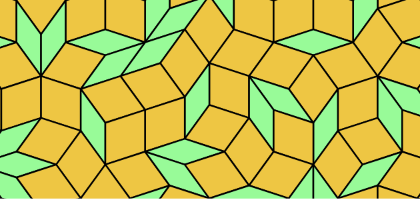
Modal Path Ethics has leaned heavily on Roger Penrose's aperiodic tiles, before later roasting him for no reason then apologizing.
A periodic tiling repeats by translation. Find the right unit and the whole plane can be reproduced from it.
Penrose tilings refuse that kind of order.

Local constraints still govern every placement, yet the plane does not collapse into translational repetition. They gave Modal Path Ethics one of its favorite visible images: lawfulness without a grid, recurrence of structure without reduction to one reusable patch, local rules generating global consequences richer than any local view.
That image later became a more explicit claim:
- functional aperiodicity.
The world is patterned enough for learning.

Bodies have recurring needs. Institutions have recurring incentives. Machines have recurring failure modes. Games produce tactical motifs. Families find astonishingly efficient ways to rediscover the same argument.
Yet no local pattern becomes a universal strategy.

A move that repairs one field may damage another. A market that coordinates one resource may destroy another relation. A legal instrument that protects one locus may export its burden elsewhere. A tactic that wins on one board can fail when the board rotates underneath it.
The phrase here was:
The field has recurring motifs without yielding a globally repeating rulebook.
That is why judgment remains necessary.
A repeating unit could support reusable prediction if an embedded agent could identify it, retain the relevant information, and actually use it at the scale of action.
Periodicity by itself grants none of those things.
A wholly chaotic world would defeat learning altogether. Functional aperiodicity therefore does not need to mean that extance literally never repeats. It names the operational condition in which recurring structure is available for learning while no usable repeating unit settles the relevant continuation problem for the agent.
Patterned enough for strategy.
Resistant enough to rote repetition that strategy has to remain in contact with the field.
Now, cosmology walks in holding an exactly periodic universe.

This is what correction is for.
If Carroll's constructed model turned out to describe our actual universe, then the broad sentence extance is not periodic would require an immediate scale condition.
Extance might be globally periodic after all.
Functional aperiodicity would then have to earn its keep where it is actually doing work. So:
- Can an embedded agent identify the repeating unit?
- Can the agent retain information across the completion of that unit?
- Can the period function as an actionable strategy rather than a fact visible only from a complete description of the whole trajectory?
- Does knowing that the universe returns after an immense cycle provide the hospital with tomorrow's diagnosis?
- Does it tell a court which witness is lying?
- Does it tell a parent what this child needs?
- Does it tell a civilization which institution will survive its own success?
- Does it tell a player what move wins this board?
If the state returns exactly, the memory of the previous complete cycle returns too: as the same memory state, not a little note arriving from outside saying:
CYCLE 84,155. WE HAVE DONE ALL THIS SHIT BEFORE.
The repetition does not automatically become available to the beings inside it as a reusable rulebook. That preserves the important part of functional aperiodicity at the scales where judgment operates.
There is also no contradiction in allowing temporal periodicity at one scale while retaining spatial or functional aperiodicity elsewhere.
- The tiles make a claim about a kind of structured non-repetition.
- Carroll's construction makes a claim about a closed quantum trajectory through time.
- One does not erase the other.
And if someday reality gives an agent a complete, usable, cross-cycle strategy guide?
Functional aperiodicity can just lose there too.
Samsara (But Without Quantum Buddhism).
There is an obvious religious temptation here. We will not be taking it.
Buddhism did not (and I did double check this) predict a finite-dimensional Hilbert space with commensurable energy eigenvalue differences.

Sean Carroll has not experimentally confirmed samsara.
Nobody gets a mystical physics coupon (today).
The resonance belongs at another level.
 Aidan Lawson

Samsara & Repair pressed Modal Path Ethics on the problem of recurrence from inside religious thought. Buddhism, treated carefully across its many traditions, places conditioned existence under a much deeper challenge than ordinary ethical reform. Repair the institution. Heal the relationship. Restore the forest. Protect the child. Reduce domination.
A Buddhist can still ask:
And then what?
- Aging remains.
- Dependence remains.
- Loss remains.
- Conditioned existence keeps producing the field in which repair becomes necessary.
Modal Path Ethics answered by conceding the boundary. It is not a liberation doctrine. It does not promise nirvana. It remains inside extance and asks what obligations persist while beings are still here to be abandoned, cared for, harmed, protected, burdened, or carried.

Exact recurrence gives that dispute a beautifully hostile thought environment.
- Suppose there is no final historical novelty.
- Suppose the cosmos comes back.
- Suppose every person, every kindness, every wound, every meaningless meeting, every excellent lunch, and every Slowbro turn returns as part of the same total physical trajectory.
- Does repair become pointless?
No.
The injury still matters without requiring an alternate uninjured universe sitting beside it for comparison.
An actual transition can harm the extant body by nontrivially degrading a structurally significant continuation or enabling structure genuinely reachable from that body before the injury.
The prison can foreclose movement, relation, communication, and exit. Abandonment can thicken resistance around a child's continuing access to care, safety, trust, and repair. A civilization can enter an institutional loop that damages the structures through which correction, succession, and handoff remain reachable.
Those are bearer-relative facts inside the path.
Cosmic recurrence does not convert them into moral equivalence.

There is one correction worth making here too.
Samsara & Repair says, and I quote myself:
The past remains past-true.
Repair does not cancel earlier contraction. Later beauty does not travel backward and make the harmful transition never have happened. The later field can still carry lost history, corrective labor, altered relations, and irrecoverable remainder.
Samsara & Repair called that surviving path-structural remainder the tail.
Do not turn that one into a secret cosmic accounting substance.

If an exact physical cycle returns to an exact physical state, Modal Path Ethics has no warrant to smuggle an invisible moral scar in from outside the physics and announce that Cycle Two secretly weighs more than Cycle One.
There is no required celestial database.
No accumulating metaphysical save file.
No karma counter hidden behind the wavefunction.
The claim is narrower:
- Within the path, what happened happened.
A repair can answer an injury without making the earlier injury false.
If the complete path later repeats exactly, the same path-structure repeats with it.
That is enough.
The Future Does Not Have to Be New.
We can finally state the result.
Modal Path Ethics does not require novelty. It requires continuability.
- A future does not become morally relevant because reality has never instantiated it before.
- A repeated future does not become morally irrelevant because reality has.
- A determined continuation does not become structurally empty because the laws and state together determine it.
- A block universe does not make a prison cell and an open door equivalent.
- An emergent clock does not make a missed repair window unreal.
- And an exactly periodic cosmos does not make Funbro healthy.
What matters inside the field remains what extant loci can genuinely continue into from here, which relations and enabling structures support those continuations, what resistance burdens the routes, which continuations have been foreclosed, and what repair remains reachable.
This also changes what we should take from Penrose.

Aperiodicity was never valuable because repetition itself was evil.
The heart repeats.
The season repeats.
The prayer repeats.
The maintenance cycle should definitely repeat.
- Penrose's tiles were important because they broke the identification of order with repetition.
- The Endless Battle then broke the identification of persistence with future.
- The Problem of Time broke the identification of future with later clock-time.
- Barontini broke the picture of the clock as external sovereign.
- Samsara & Repair broke the hope that repair must become purity to remain worth doing.
- Carroll's cyclic model now breaks the last easy identification:
- future with novelty.
There was too much sitting on that word anyway.
The framework becomes smaller and harder.
A future, in the framework's shorthand, is a reachable continuation for an extant locus from the field as it actually stands.
It can be new. It can be old.
It can be strange. It can be determined.
It can be part of a universe that has done the whole thing before.
The question remains what the relevant loci can actually reach from here.
Then Hand the Future Away.
There is one more mistake available.
Once metaphysical openness has been stripped away, a founder can decide that the future has therefore lost its claim to authorship.
- If the trajectory is fixed, why preserve correction?
- If the same structures recur, why leave institutions revisable?
- If a sufficiently intelligent system can predict later needs, why not build the final interface now?
- If we know enough about what comes next, why let the next participant answer?
Physics grants none of those permissions.
A cyclic universe does not appoint its earliest engineer king.
Determinism does not turn prediction into consent.
Capability does not become jurisdiction because the predicted path is accurate.
Chronology does not become title.
The future may already belong to the structure of reality.
It still does not belong to us.
We cannot guarantee that whoever comes later will inhabit a metaphysically open universe.
We can still decide whether the people and institutions inside that universe inherit materially reachable routes of objection, correction, revision, exit, and succession.
There is the remaining problem.
- The future does not have to be new.
- The loci inside it still have to be able to answer.
